
Case study

Cheesecake Labs: The Proprietary AI Harness

From fragmented AI wins to company-level IP.

A 150-person engineering partner with 300+ projects delivered had great AI practices trapped inside individual squads. Four months later, those practices are one proprietary harness: business IP that onboards people, guarantees a quality baseline on every project, and sells as a service.

We won a large deal against a global consultancy many times our size. That client would not have closed with us before this work.
MarcelloCEO, Cheesecake Labs

What changed

10× ROIon the engagement
40 featuresin 4 weeks, one engineer on the standard flow
4h → 10minspec writing, one PM’s workflow, now every squad’s default
2 days → 15minweekly client reports, on every project via Project Knowledge
20% faster, 30% fewer bugson a mature codebase, not a greenfield demo
New revenue linepaid AI assessments and spec-driven workshops at client sites

Cheesecake Labs’ own engineers and PMs shipped the delivery results above. The harness is what made them repeatable.

Before days Now hours
Onboarding. Every new person comes in through the harness.
Project Knowledge
Project Knowledge (aka Company OS). Built per project, so people rotate and the context stays.
It processes the whole week, meetings, emails, messages, in 10 to 15 minutes and generates the status report. Before, to get that same quality of context and data, it would take me a full day, easily two.

OhanaAI Product Manager
The biggest advantage right now is giving visibility of our work to the client. The other is that I’m catching tasks and project risks that were slipping through because of the sheer volume of calls.
RodrigoProduct Manager

How

Agentic development had been live since late 2024, but the best workflows lived in personal workspaces and left with the person. We pulled what worked from every squad into one company-level harness, on three pillars:

The efficiencies were there, but isolated. Consolidating them organically was taking too long. What we needed was speed to turn them into a proprietary harness.

DougCTO, Cheesecake Labs

Governance and standards

Owned by engineering managers, proven by pilot teams on live projects.

Enablement

A harness for the whole SDLC, plus Project Knowledge, a per-project context layer that survives team changes.

Measurement

Live adoption tracking per development phase, squad, and person.
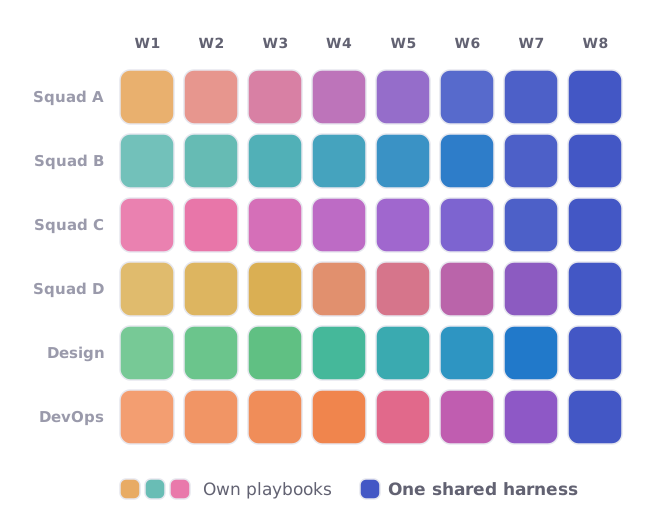
Adoption matrix: every squad starts on its own playbook, in its own colour, and shifts week by week onto the same shared AI harness, arriving together by week eight
Each squad starts on its own playbook and converged on the shared harness.

What the team says

MarcelloCEO, Cheesecake Labs
We tried another consultant from LA first and it failed. Lucas understood our problem before the technology and delivered exceptional value.
DougCTO, Cheesecake Labs
We knew what we wanted to build. We just didn’t have a single manager with the capacity to drive it. Lucas took the patterns emerging in isolated squads and brought them up to a proprietary AI harness at company level, fast. Today that AI harness is how we onboard people and guarantee efficiency across every project.
Once people saw this AI work happening, they pulled themselves toward it. Today it’s just the norm here. I don’t have to push anymore. The team pushes the system forward.
The company is now enabled to run this process outward, not just internally. We’ve already delivered AI assessments for clients and we’re running spec-driven-development workshops inside them.
Lucas’ work is well worth the investment. It’s an investment we’d never made in the operation: bringing product consulting in.
I didn’t expect Lucas to talk to that many people at Cheesecake. I was positively impressed. I assumed he’d stay in a layer of two or three people. Today half the company knows Lucas at some level. For the rollout, Lucas already has direct contact; it doesn’t have to route through me.
LarissaHead of Product and Design
Highly effective. Lucas handled it autonomously: brought ideas, structure, and follow-through. In the end, the last thing we wanted was to have to manage the consultant.
Lucas brought sequencing to the work. Moving forward, even slowly, but not leaving things loose. What we gained with Project Knowledge and the feedback work was very effective. It’s something we could never land before.
The objectivity, and the bias toward resolving things. Even in the conversations that stayed ambiguous, he always brought the lens of “OK, given all this, what’s the next step?” And the willingness to go connect with other parts of the company. I have one view, Ohana has another, Doug has another. Lucas played that facilitator role: showing where we could go, or where we had a blind spot.
OhanaAI Product Manager
The first impact was visibility and connection between everyone. But the big shift was the process: Lucas brought the structure for people to look at this the right way. It’s not a skill here and there, it’s a whole new software development lifecycle. It’s much less about each person defining their own standard, and much more about the company defining it, connecting the best of what people already had.
Lucas amplified small things I didn’t think were worth much. My PRD workflow was “basic and good enough”. Lucas merged my view with what other squads were doing, pulling what worked from every harness into a company standard. Today other teams use it daily and it made my own flow better. That was a big validation.
We already had isolated efficiencies across squads. What we were missing was an accelerator. We needed some of it internalized by leadership, especially the capacity question. Lucas was that bridge.
Lucas generated the autonomy for the internal team to manage itself. The role is to be the catalyst, but also to leave a base so people keep going and keep raising the bar.
The biggest gain isn’t how much everyone uses it. It’s having the structure defined and every piece of project information continuously documented.
DaniloEngineering Manager
Lucas set the standard we needed to get going: the skeleton of the process. The repository, the skills, the plugins, how to configure them, how to share them, who owns each project and how they validate. It defines a minimum bar to follow, and it creates self-accountability: now we notice when we’re not doing what we committed to.
The gain isn’t just raw speed. It’s how much I can handle: projects I couldn’t give attention to before, now I can go deeper and actually support the devs.
I really liked the way it started: the interviews to understand each person’s pain points. They even force you into self-reflection. And the whole process is amazing: coming back, pulling the groups together, assigning owners, defining how things get validated.
Sometimes we think we’re doing something amazing, then someone from the outside brings a completely different view. It’s good to have that outside view, to strip out our own biases.
It was valuable, and it still is. We’ve already asked Doug to bring this kind of consulting back once the pace is more predictable.

Have AI wins stuck inside one team?

Book 30min. We look at what your teams already do well and what it takes to make that the standard.

Get in Touch Back to all work